

Here’s an uncomfortable update for those of you doing SEO the old school way. According to Bain and Co., 80% of consumers now rely on something called ‘zero-click’ results. These are the AI responses on that appear on the top of SERPs that satisfy the searchers requirements without the need to click on a link.
Generative Engine Optimisation (GEO) focuses on increasing the chances of your content being included in those zero-click responses.
A Which? survey found that 51% of UK adults use AI search tools to search for products, services, and advice online.
For businesses in the UK, this means that GEO is becoming increasingly important, and working with a top digital marketing company can help boost visibility and reach potential customers.
What Is Generative Engine Optimisation?
Generative Engine Optimisation, usually called GEO, is the practice of improving content AI systems like ChatGPT, Gemini, Claude, Copilot and Perplexity are more likely to use it when answering a search query.
These systems do not just show a list of links. They create an answer by taking information from sources and choosing which ones are reliable.
The term GEO was introduced in a 2023 research paper. The paper looked at how websites can be more visible in AI-generated answers. Researchers found that certain content formats help. These include citations, statistics and information with sources. Such content is more likely to be included in AI answers.
People now search differently. They do not just use search engines. Many ask AI systems directly for an answer, and they expect this answer without having to open tabs.
GEO helps content creators make their information useful, for AI systems, so as to ensure that their content is more visible to searchers.
GEO vs SEO
SEO and GEO tackle related issues, but their goals are different. SEO basically forms the base, and GEO is the advanced layer above it.
SEO is about making pages show up in SERP (search engine results pages). When it comes to SEO services, usually the aim is to get clicks, visits and engagement from search engines like Google and Bing.
On the other hand, GEO is about getting your brand, article, product or expert source mentioned in an AI-generated answer.
The key difference is that an AI assistant can answer a question without displaying a typical list of 10 blue SERP links. It now synthesises information from multiple sources and only mentions a few. If your content is not pulled during this process, ranking high might not be enough.
It’s crucial to understand that GEO isn’t a replacement for SEO. Most AI systems still rely on factors that matter in search, such as content quality, authority, structure and relevance to a topic. Good SEO provides AI systems with a source to use. GEO builds on that foundation.
|
SEO |
GEO |
|
Optimises for rankings in search results |
Optimises for mentions and citations in AI answers |
|
Measures clicks, rankings, and traffic |
Measures visibility inside generated responses |
|
Targets search engines |
Targets AI-powered answer systems |
|
Focuses on earning visits |
Focuses on being referenced as a source |
|
User chooses which link to open |
AI chooses which source to include |
Is SEO Dead or Evolving in 2026?
No, SEO is not irrelevant in 2026. But, there has been a drastic change in the way people discover information online, where search behaviour has now spread across search engines, social media, AI assistants, and answer engines.
Google continues to process billions of searches every day, which means websites continue to depend on organic visibility. At the same time, AI-generated answers are significantly reducing the number of clicks for some informational searches because users often get an answer directly on the screen.
Read more: Why SEO Matters More Than Ever in the Age of AI Search.
As you can see below, AI blocks take up the most prominent spots at the top of search results, pushing organic links below the fold.
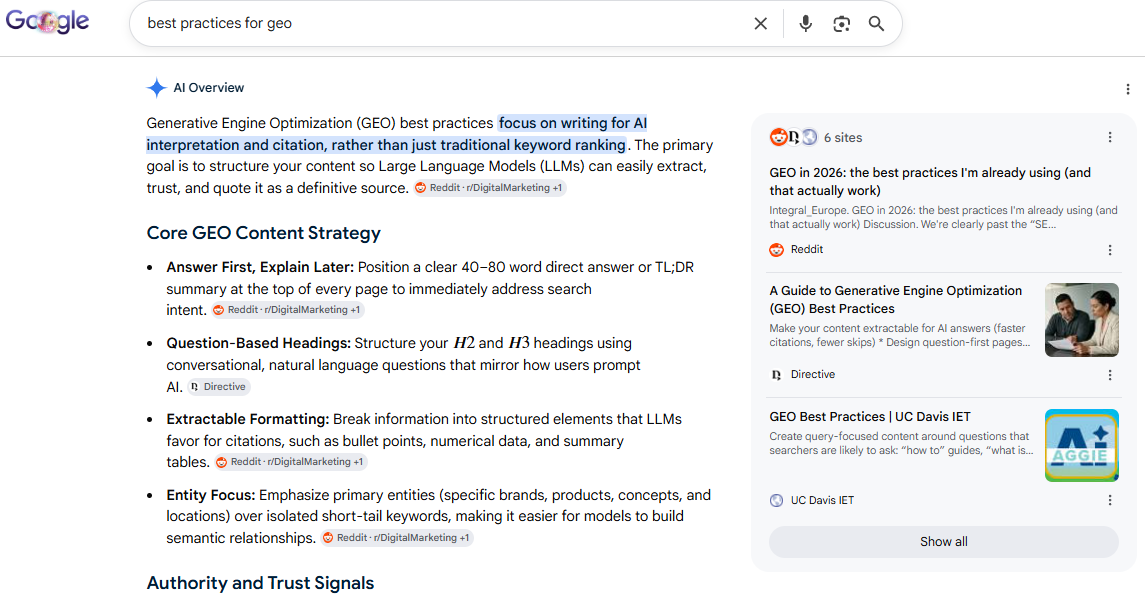
It is important to realise that AI systems still need trustworthy sources, as they do not create information from a vacuum. They retrieve, evaluate, and summarise information that already exists across the web.
So, don’t worry. Content accuracy, subject expertise, citations, and topical depth will continue to matter.
SEO in 2026 has a broader scope than it did a few years ago. While ranking pages remains important, brands also need content that AI systems can understand, verify, and cite.
5 GEO Practices To Boost AI Visibility
You should know that when AI systems process your content, they are actually looking for signals they can verify, attribute, and understand with confidence.
At this point, businesses in the UK have no other choice but to sharpen their online content using proven GEO best practices.
1. Publish Information That Can Be Traced Back To A Source
AI systems prefer information that has an identifiable origin. Research findings, industry reports, expert commentary, government data, and documented case studies are easier to cite than unsupported opinions.
The original GEO research found that adding citations, quotations, and statistics increased visibility in generative engine responses by as much as 40%.
That figure comes from the paper that introduced GEO itself, not from a marketing blog repeating second-hand claims. If a number, statement, or recommendation appears in your content, it is best to include a link to the source.
2. Structure Answers The Way People Actually Ask Questions
How do you usually frame your prompts on ChatGPT, Claude and so on?
You, like most users, would tend to ask complete questions in natural language rather than type short keywords.
Taking that into consideration, your content needs to directly answer specific questions in your niche, because long promotional copy would not help you. Direct, helpful answers will get pulled and cited by AI systems.
For a detailed idea on how to do this, you can check our Simple Guide To Conduct Prompt Research.
Maybe the easiest test is reading your page as if you were the person asking the question. If someone searched “How does GEO differ from SEO?”, would they find a direct answer within seconds?
The point is, sections with clear headings, concise explanations, and question-based formatting give retrieval systems less work to do when generating a response.
3. Build Evidence Beyond Your Own Website
A website can claim almost anything about itself. AI systems have access to a much larger pool of information.
A Cornell University study found that when AI systems choose between sources, the biggest factors are:
-
topical relevance
-
completeness
-
trust cues
-
recent information
Research papers, industry publications, news coverage, expert commentary, review platforms, and professional communities often provide additional context about a company, product, or topic.
Now, when retrieval systems notice the same expertise or claim appears across multiple credible sources, it becomes easier for these systems to understand what that source is known for.
That is one reason why original research, expert contributions, published case studies, and citations from recognised industry sources tend to have more value than publishing larger volumes of similar content on your own website.
4. Keep Important Pages Updated With Current Information
If you expect AI systems to pull your content, you would have to make sure the information you write is updated enough to answer user prompts or queries.
In fact, updated information on web pages serves as trust signals to AI systems, telling them that the content is fresh and relevant.
According to Google’s Search Quality Evaluator Guidelines, when a query demands recent content, only pages with current, recent, or updated content should get high ‘Needs Met’ ratings.
It’s good to conduct a regular audit to ensure you update:
-
old statistics
-
outdated product information
-
expired recommendations
You could just review your highest-traffic pages every quarter and replace outdated figures, broken references, and obsolete recommendations. That, of course, takes far less effort than publishing dozens of new articles that repeat information already available elsewhere.
5. Make Content Easy For Machines To Interpret
The content structure of your website, online store, blog and so on can influence whether or not AI systems cite you as a source.
What’s become clear is that AI retrieval systems find is easy to process well-structured headings, sections, schema markup, definitions, tables, and clearly separated ideas. They struggle with pages filled with dense blocks of text.
That does not mean you should turn every article or page into a checklist. But you can make an effort to organise information logically so both people and AI systems can identify what each section is trying to explain.
To start off, you can implement schema markup, a code to structure your data in a way that both search engines and AI systems can read it easily.
Just to give you an idea, this is what schema markup looks like.

Work with a Top Digital Marketing Agency in London
For years, content optimisation focused on helping a page appear higher in search results.
Now the challenge is different. AI systems often decide which sources deserve to be quoted before a user ever reaches a website.
In the UK, sites gaining visibility are usually the ones publishing verifiable information, expert knowledge, and content that answers a question directly instead of circling around it.
If you are looking for digital marketing experts in London to increase your AI visibility, Webskitters can help.
Book a call with our digital marketing experts and tell us your needs.
Frequently Asked Questions
1. What is Generative Engine Optimisation (GEO)?
Generative Engine Optimisation (GEO) helps businesses increase their visibility in AI-generated answers, making it easier for potential customers to discover their products and services.
2. How is GEO different from SEO?
SEO aims to improve rankings in search results, while GEO focuses on increasing the chances of being referenced in AI-generated responses and answer engines.
3. Does GEO replace SEO?
No. GEO builds on SEO rather than replacing it. Strong SEO helps content get discovered, while GEO helps it become a source AI systems choose to cite.
4. What content performs best for GEO?
Content supported by credible sources, expert insights, original data, and clear explanations tends to perform better because AI systems can verify and attribute it.
5. What are GEO best practices?
Use reliable sources, answer questions directly, organise content clearly, keep information current, and demonstrate expertise with evidence that can be independently verified.
