


This just in. According to Search Engine Land, AI-powered search has cut LinkedIn’s B2B traffic by around 60%. This shows that generative search delivers answers without clicks. Now, you may be wondering why SEO matters or is SEO dead. Well, let’s see.
If you expect to appear in AI results, you necessarily have to be ranked in the top SEO search results.
Why?
Because AI overviews and summaries are pulled directly from these top-ranking pages. And how do you secure those positions? Through strong SEO and organic marketing strategies,often guided by the best seo service providers in the uk who understand how to optimise for both traditional and AI-driven search.
Below, we have listed the top SERP features driven by AI and user intent.
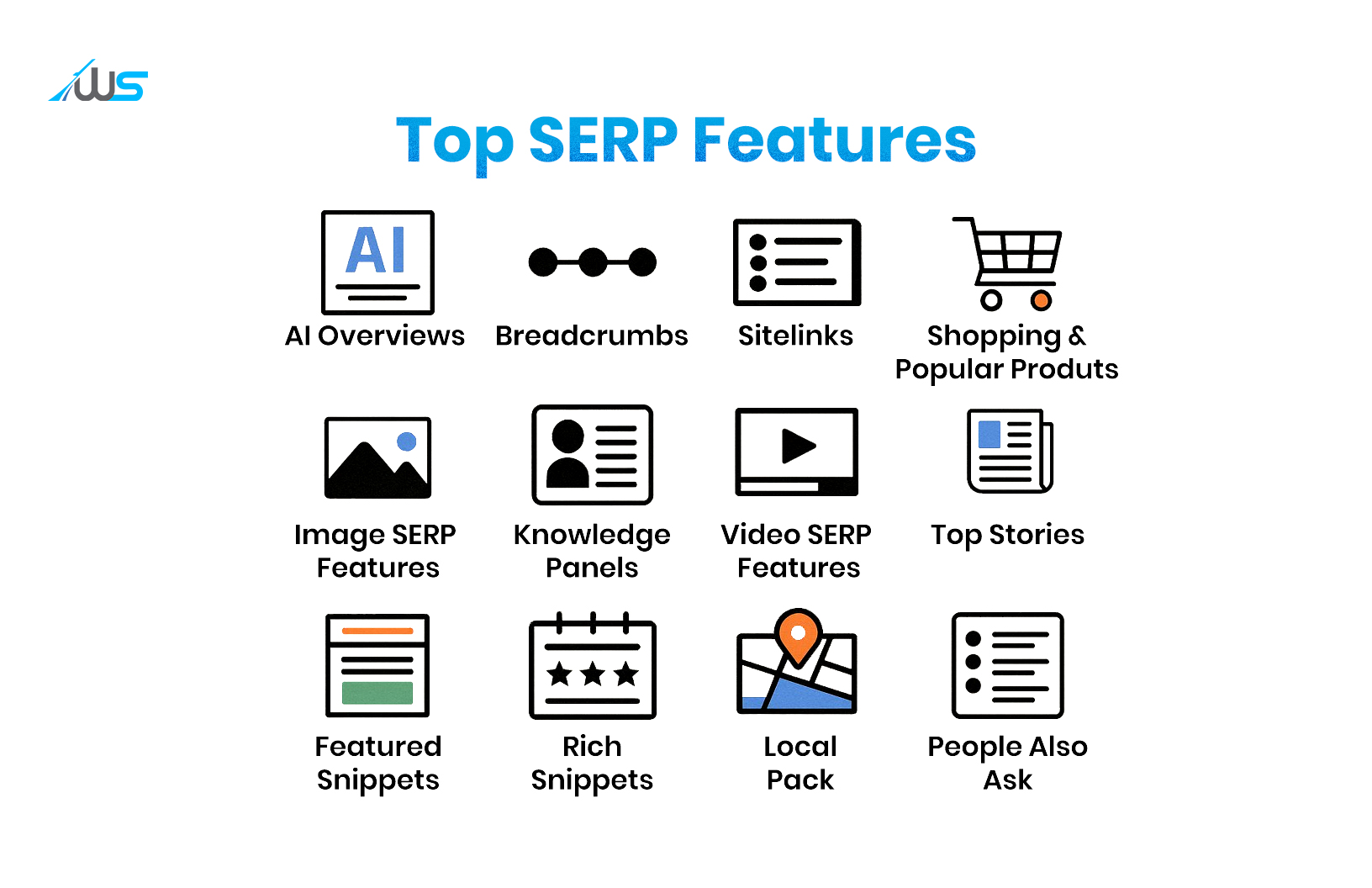
Are you looking for strategies to get surfaced on AI search engines? Let’s look at the best practices that top businesses are leveraging to get found on AI results.
Before you implement AI SEO, it’s good to have some context of what SEO can offer your business, how SEO is evolving, and what the new terms like AEO & GEO are all about.
What Are the Main Benefits of SEO?
High visibility, qualified leads, and enhanced credibility are the top benefits that any business can expect from a well-planned SEO strategy.
It helps your website appear when people are actively searching for solutions, which means the traffic you receive is more likely to convert.
94% of all clicks are clicks on the unpaid results or organic results you see on SERPs. This indicates that people trust these results more than other types. They still gravitate toward what appears earned, rather than the sponsored results.
1. Increases Your Visibility and Ranking
Be honest, how often do you scroll past the first few results? Rarely, right? Placement shapes perception.
When your pages consistently appear near the top, you become familiar, which then turns into credibility.
Over time, search engines learn to associate your domain with specific topics, and users begin to recognise your name before they even click.
Did you know repeated organic exposure increases branded searches later? Visibility quietly compounds.
2. Boosts Web Traffic (Featured Snippet)
The featured snippet is the place to be. That small block of text carries authority.
Suppose a searcher types a question and your content appears above all traditional listings in a highlighted answer box.
The best part is that even if the user does not immediately click anything, the search engine associates your brand with expertise.
Featured snippets allow:
-
Higher visibility above standard listings
-
Stronger perceived credibility instantly
-
Traffic driven by precise queries
-
Brand recall beyond the click
3. Increases Your Conversions
Say someone looks up “affordable CRM for startups,” they are obviously not browsing casually. The search query makes you realise that they are trying to compare and narrow down their choices.
With SEO, you get to align your products or services with these intent signals.
You won’t be hard-selling, but instead you would be able cater to a need that has already been expressed.
But how can SEO boost conversions? This is because:
-
The user is already problem-aware
-
The solution is contextually aligned
-
Friction is reduced on landing
-
Trust builds through relevance
4. Offers Visibility Across the Funnel
It’s quite rare for someone to buy something online in just one search. People typically go through phases like curiosity, comparison, validation, and so on.
You can take advantage of each of these phases if you use SEO.
How?
Someone might search “how to improve website ranking on Google.” Later, they compare “SEO agency vs in-house team. Just before making a decision, they might look up “top SEO agencies reviews and pricing.”
Now, imagine if your content appears at each of these stages. It increases the likelihood of people reaching your offerings as their decision becomes increasingly clear.
5. Creates Positive Customer Experience
Do you know why sites like Search Engine Land, Ahrefs, and Semrush consistently rank high? It’s because they all have well-organised websites.
Basically, the use of SEO to improve their site’s structure ensures that pages load faster. navigation becomes logical, and the headings of the web page follow a logical hierarchy.
If the information on your website flows logically and people can find answers easily, they will stay longer and keep returning.
6. Showcases Your Domain Authority
Some websites only give surface-level information, without being concerned about the actual needs of visitors.
On the other hand, good websites publish relevant and highly authoritative information.
It is that latter that attracts quality backlinks (these are hyperlinks on other websites that point to a page on your own website).
The right SEO techniques allow you to build consistent, high-quality backlinks. This can lead to better rankings on SERPs.
Note: There’s no shortcut to this. You would actually have to develop high-value assets such as original research, data-driven infographics, and comprehensive guides in order to earn backlinks.
Search Everywhere Optimization is The New SEO
Google’s Danny Sullivan says, “One of the ways to be successful with Google Search is to think beyond it.”
This makes sense when you realise that people conduct searches everywhere from TikTok to YouTube, social media channels and (particularly now) on generative engines.
Your brand’s SEO tactics need to adapt to several different online platforms on which users spend time.
Why It Matters Today
Search everywhere optimisation works on two fronts:
Users are searching everywhere
AI is pulling from everywhere to synthesize, summarize, and cite information.
When you ask an AI a question, it doesn’t just look at websites. It “searches everywhere” across social media, reviews, and forums to give you an answer.
Additionally, Gen Z and even a good percentage of Millennials conduct searches on atypical places like AI platforms, ecommerce sites, and social media.
So, in case your brand is absent from those platforms, AI systems that scan those platforms will not find you there.
SEO Vs GEO and AEO
You may have come across a bunch of new acronyms in the SEO sphere, such as AEO, GEO, AIO, and so on.
With all these terms thrown around, it is easy to think that SEO has become obsolete. But,Search Engine Land’s Lilly Ray confirms, it has not.
Advances in AI technology and shifts in user behaviour are responsible for these shiny new terms.
Let’s have a look at what they mean.
What Is Traditional SEO?
Traditional SEO is the baseline approach where you optimize your website, aiming to rank high on organic search results.
You would typically have to align your website content with keywords, earn backlinks, and improve site experience.
It would be a mistake to dismiss this basic level of SEO, as many AI systems rely on indexed search data before generating responses.
What Is AEO (Answer Engine Optimization)?
When someone uses voice search, they expect clarity immediately. AEO prepares your content for that extraction. Clear definitions, structured FAQs, and concise responses make it easier for answer engines to lift your insight directly.
The AEO approach is where you prepare your content in a way that allows you to appear on AI-generated answers, typically on SERPs and featured snippet boxes. These are usually extracted from specific content from a single webpage.
You can conduct AEO by writing clear definitions, structured FAQs, and concise responses. This will make it easier for answer engines like ChatGPT and Perplexity to lift your insight directly.
The AEO approach often involves:
-
Direct question-based headings
-
Concise explanatory paragraphs
-
Logical content sequencing
-
Structured data support
What Is GEO (Generative Engine Optimization)?
To carry out GEO, make your content clear, authoritative, and context-rich so AI systems can understand and trust it.
If it’s well-structured and credible, then there is a higher chance the AI will reference, summarise, or synthesise your insights at the top of Google’s search results page in an AI Overview or inside a ChatGPT answer window.
Note: Generative tools are more likely to incorporate perspectives that demonstrate completeness rather than surface-level commentary.
Learn more: GEO vs SEO: The Ultimate Battle for Web Traffic Dominance
The Rise of Zero-Click Search
Research from SparkToro shows that over half of Google searches end without a click. Whether you like it or not, currently, AI overviews, featured snippets, knowledge panels, and so on are leading to zero-click searches or position zero.
It has got a lot of businesses worried.
But you can take advantage of this by providing direct answers and building your brand authority even without the need to click through to the website.
Some ways to optimise your content for Zero Click Search include:
-
Schema markup
-
Concise paragraph snippets
-
Comparison tables
-
Definition-style content
-
Scannable headers
How SEO, AEO & GEO Work Together
At this point in the age of AI, you would need to do everything you can to maximize visibility.
Suppose that a person has come across your business via three different points. They may first find you through an article on SERPs. Later, through a concise answer read aloud by a voice assistant. Then through a generative summary that references your expertise.
SEO lays the foundation, AEO offers the instant answer, and GEO boosts your AI authority.
So you see, these systems overlap.
|
Approach |
Primary Role |
Where It Appears |
|
SEO |
Earn visibility in search listings |
Organic SERPs |
|
AEO |
Provide extractable direct answers |
Voice and snippets |
|
GEO |
Influence AI-generated summaries |
Generative platforms |
7 Ways to Prepare Your Website for AI SEO
Since it’s clear that search behaviour is shifting toward AI summaries and conversational results, it makes sense for businesses to optimise their content accordingly.
Let’s explore what that entails.
1. Create Clear, Structured Content
How do you read online? Most people scan first and then decide to stay later. AI systems behave in a similar way because of this. These systems check various pages, looking for hierarchy, cues, and context before deciding from where to extract.
When your ideas flow logically, both readers and machines can follow your content. Logical headings, short summaries, FAQs, and detailed explanations are the best ways to achieve this high-level structure.
This is what AI systems expect and seek. Search algorithms get organised insights that they can summarise and trust.
2. Use Schema Markup Extensively
Schema markup labels your website content, using a standardized semantic vocabulary. It tells search engines whether they are looking at a service, a product, an event, a local business, and so forth.
The reason why you need to add schema markup is that it gives search engines clear labels about what your content contains. It indirectly allows AI to match your pages to relevant user queries.
This high-level structure allows search engines to display extra details such as star ratings, prices, FAQs, or event dates directly in the search results and not just a standard blue link.
3. Optimize for Conversational Queries
When you speak to an AI assistant, you rarely mention two fragmented words. You ask full questions.
ChatGPT, Perplexity, and Google AI Overviews optimize content for conversational, long-tail queries by directly answering user questions in a natural tone.
You can write your headings the same way people ask questions in real life.
So, if someone types, “How does AI SEO affect ecommerce traffic?” use that exact question as your heading instead of shortening it to “AI SEO ecommerce traffic.”
Search engines and AI tools are better at understanding complete questions, so they can more easily match your page to what the person is asking.
4. Build Topical Authority and Trust
The need for building topical authority is not a cause for concern.
You should see it as an opportunity to showcase to their target audience that they are the authority on the subject.
Your content should have consistency, depth, and credible references. It’s also good when you fill any content gaps within your core expertise.
If you offer surface-level information for many topics, you can’t expect to establish your expertise.
On the other hand, if you create in-depth pages, your content is more likely to be included in AI-generated summaries and search overviews.
Topical authority is built when you:
-
Explore connected subtopics with consistent depth
-
Reference credible research and primary data
-
Maintain a visible, consistent author identity
-
Earn citations from relevant reputable sources
5. Expand Keyword Strategy for Semantic Context
If you look closely at modern ranking behaviour, you will notice that context often outweighs keyword repetition. Machines have now been trained to interpret relationships between ideas.
The reason why semantic expansion is important is that it takes into account real-world expertise.
Say you have a page discussing AI SEO, then it only makes sense to include related areas such as structured data, zero-click behaviour, and answer extraction in the conversation.
With this in mind, what works is layering related subtopics to demonstrate your breadth of expertise.
Both people and bots will see that you understand the ecosystem and not merely a phrase. For the most part, this broader relevance improves how confidently AI systems synthesise your insights.
6. Prepare for Zero-Click Metrics
Because of the way search engines work these days, as a business, you may find that your clicks have declined, but strangely, your visibility has increased.
Yes, that can feel counterintuitive.
In fact, AI-generated summaries may present your insights directly on the results screen; despite this, traffic numbers may not immediately rise.
It’s obvious that exposure now appears in more places, including featured snippets, AI overviews, voice responses, and more.
What is important is to measure beyond raw traffic.
Consider tracking:
-
Search impressions and snippet inclusions
-
Branded query growth over time
-
Mentions within AI-generated summaries
-
Engagement depth after AI referrals
7. Monitor and Adapt to AI Search Signals
Even the search interfaces are not going to be the same for long as they keep evolving.
If you monitor snippet volatility and AI overview patterns, you gain early insight into behavioural changes.
The best part is that adaptability does not require a complete revamp. What you can do is refine summaries, expand explanations where clarity is thin, and strengthen internal linking where your context
lacks a clear hierarchy.
It has been found that when AI models scan high-authority, well-structured content, they are attracted toward reliable sources.
So, all you need to do is maintain clarity, authority, and context together, and your content will be well-positioned for inclusion across rankings, snippets, voice outputs, and AI-generated answers.
Why SEO Must Evolve in the AI Era
All AI-generated answer draws from indexed pages, structured data, and authoritative domains.
Without SEO foundations, there is nothing reliable to reference.
What is changing is not the importance of SEO, but the surfaces where its impact appears.
The right approach would be to conduct SEO as evolving infrastructure which will help your brand remain visible across traditional search and AI-driven discovery.
You can partner with Webskitters to build a strategy that optimises your content for AI-powered search experiences.
Our experienced digital marketing team can help you align structure, content, and data so your brand stays competitive as search technology continues to evolve.
Get in touch with our SEO experts.
Frequently Asked Questions
1. How do I know if my website is ready for AI search?
If your site has clear structure, detailed topic coverage, and updated content, you’re on the right track. If it feels thin or scattered, improvements are needed.
2. Will AI search reduce traffic to my website?
It can reduce some clicks, especially for simple questions. However, it can also increase brand visibility and attract more qualified visitors over time.
3. Do I need to change my entire SEO strategy?
Not entirely. You need to strengthen what you already have by improving clarity, authority, and structure so AI systems can better understand your content.
4. Is AI SEO only important for large companies?
No. Smaller businesses can benefit significantly because clear expertise and focused topics often compete well against broader, less specialised larger websites.
