

For any healthcare business, mobile apps are a must as they offer a quicker and more convenient ways of delivering and accessing medical treatment.
Various healthcare apps are being deployed to help users book their appointments, speak with doctors, view reports, and even to track their fitness. The end goal is to make healthcare highly accessible to all.
The steady technological advancements have made it natural for more and more people to turn to mobile apps for their healthcare requirements.
The question is, what apps are used in healthcare? From electronic health records to appointment scheduling and telehealth apps, there is a wide range of healthcare apps that cater to both professionals and patients.
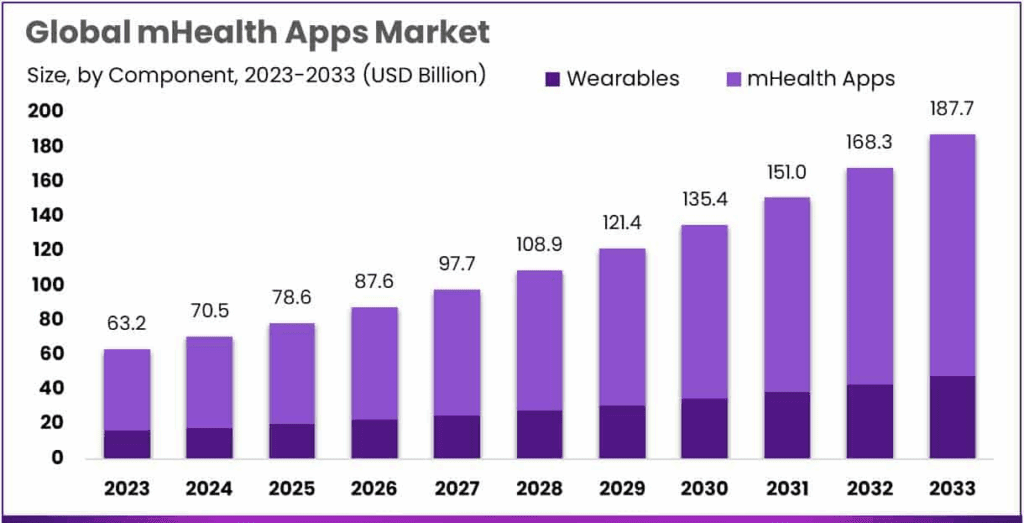
The number of health and fitness mobile applications on the market has massively increased, and as you can see from the graph above, the projections show this trend will continue for years to come.
In mid-2024, 35,019 medical and healthcare apps were available on the Apple App Store. The market is projected to grow even more in 2026. Partnering with a mobile app development company in London can help businesses create innovative and user-friendly healthcare solutions.
Clinics, healthcare providers, and hospitals invest heavily in healthcare mobile app solutions to offer patients better care while improving their business efficiency.
As a healthcare business owner, are you still in a dilemma? Worry no more!
In this blog, we will explore how healthcare businesses can leverage mobile apps for enhanced efficiency and discuss the benefits, challenges, and trends shaping the industry in 2026.
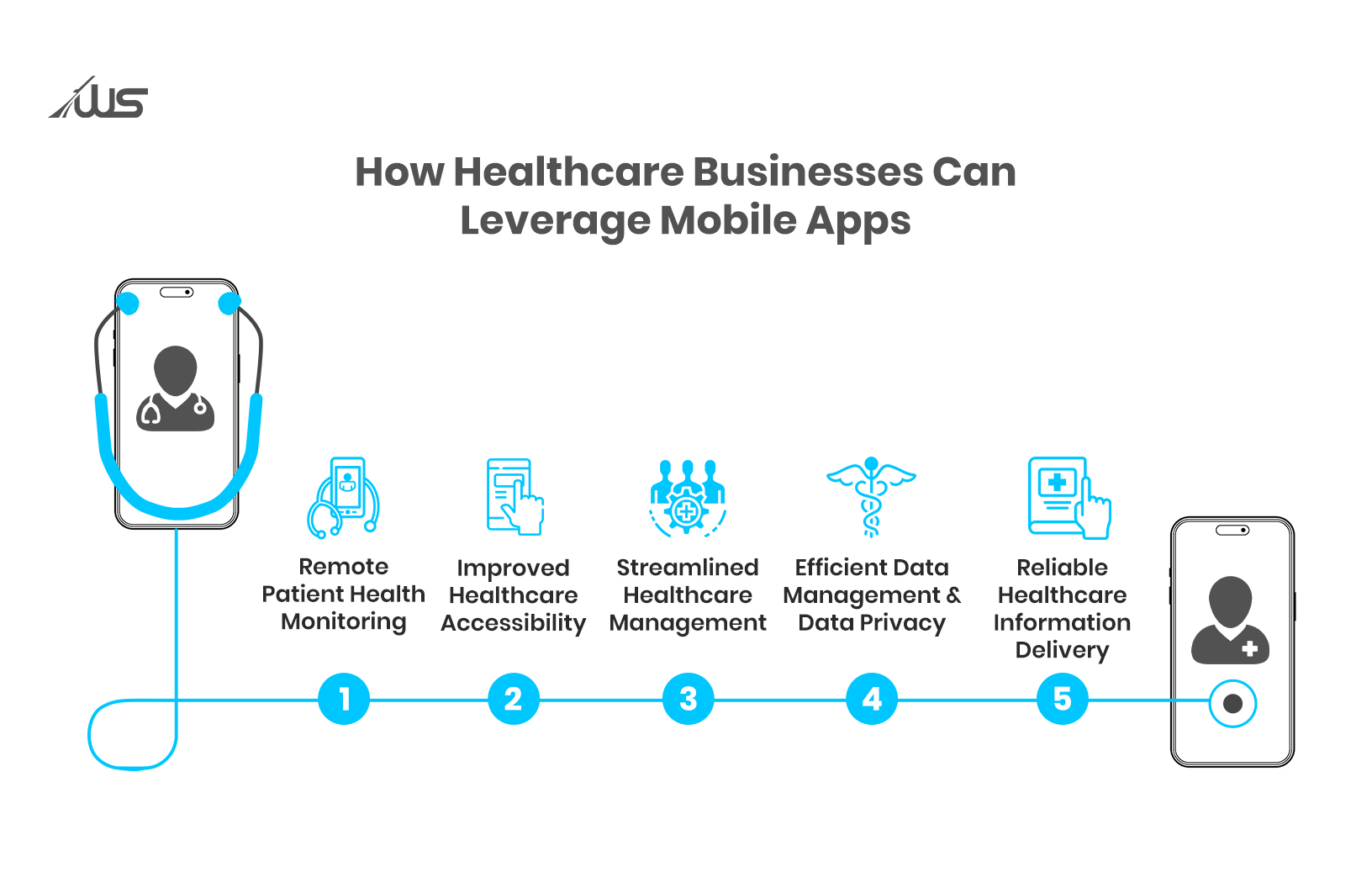
How Can Healthcare Businesses Leverage Mobile Apps?
Did you know that the global healthcare application market size was valued at around USD 114 billion in 2024?
The above data suggests that healthcare businesses are efficiently leveraging mHealth applications. And, what are the most common healthcare software or apps? Some of the popular healthcare apps are built to improve hospital and clinic operations, support doctors with clearer diagnoses, and give patients easy access to telehealth.
So, how do businesses do that? Let’s explore.
1. Monitoring Patient’s Health Remotely
The features of a mobile app for healthcare businesses can be customised according to specific needs. Telemedicine consultations through these
platforms allow patients to access medical advice remotely, breaking geographical barriers while ensuring timely medical service.
What’s more, medication reminders help promote adherence and enhance treatment efficacy. All while reducing the likelihood of missed medicine doses. The symptom-tracking functionality empowers patients to monitor their health in real time. This encourages proactive management, which fosters better health outcomes and improved patient well-being.
Ultimately, healthcare businesses are able to provide superior results to their patients, which is in turn raises their reputation.
2. Healthcare Accessibility
There is no denying the fact that mobile applications enhance accessibility. They are particularly useful for isolated or underserved areas. They overcome logistical barriers and bridge geographical gaps. These platforms allow individuals to remotely access expert advice, healthcare resources, and expert advice.
Apps like these are also designed to disseminate verified medical information to populations with limited healthcare access. It could be anything from educational resources, critical health information, and preventive care guidance to provide value to the underserved communities.
Businesses can improve the reach of their healthcare services by empowering communities to receive timely medical support and better quality care.
3. Healthcare Management
Mobile apps for healthcare businesses significantly enhance business productivity and efficiency by streamlining different aspects of healthcare management. These applications simplify administrative tasks such as patient record management, billing procedures, and appointment scheduling. They reduce paperwork and mitigate administrative issues for businesses.
Plus, they facilitate smoother and quicker access to patient information. Doctors and other healthcare professionals can make better decisions more efficiently and quickly.
It has been found that mobile apps for healthcare businesses considerably improve care coordination among multidisciplinary teams. This is because they enable stronger collaboration and communication.
4. Data Management and Data Privacy
Data management is a crucial aspect of the healthcare sector. Through the usage of custom mobile apps, it becomes possible for healthcare professionals to ensure organised and accurate documentation.
These applications also enable the maintenance of comprehensive Electronic Health Records (EHRs). They help consolidate patient data such as test results, treatment plans, medications, and medical histories.
Most importantly, these platforms comply with stringent regulations when it comes to privacy. They employ robust security measures such as authentication protocols and encryption to safeguard patient information.
This ensures confidentiality while adhering to privacy standards, namely HIPAA (Health Insurance Portability and Accountability Act), 1996. These HIPAA-compliant mobile apps, in turn, can help build trust among the patients and boost your business’s reputation regarding patient privacy and security.
5. Healthcare Education and Awareness
Particularly among Millennials and Gen Z, there is a high demand for mobile apps that offer healthcare literacy and awareness in a convenient way. Apps like these provide an interactive, accessible platform for the dissemination of crucial healthcare information.
You get a wide range of educational content, such as infographics, videos, interactive modules, and articles, catering to different learning preferences and styles.
Of course, features like notifications and real-time updates empower users to stay conscious of the prevalent health problems as well as the preventive measures they can take.
Users also leverage these apps to engage with others through forums and also to access to expert advice from healthcare professionals. All of these foster an environment of informed decision-making and continuous learning.
And, from a business perspective, it helps you grow brand authority for your business. This can lead to patient retention and engagement while driving growth for your healthcare business.
Benefits of Mobile Healthcare Apps
Doctors, patients, and healthcare businesses all benefit from mobile applications. The reason is simple, they significantly improve efficiency and accessibility. You would need to check what healthcare apps are useful to your business.
So, let’s explore three key benefits of mobile apps for healthcare businesses.
1. Simplifying Records
Mobile apps drastically enhance the efficiency of storing medical information. Most of these apps enable patients to input their data manually, tracking sleep, exercise, and diet habits to accurately report to a healthcare expert.
So, a diabetes management app has features for monitoring blood sugar levels and nutritional intake. This means the patients can have their medical history readily accessible for consultations. This results in smoother business management, which can enhance your operational efficiency.
2. Enhancing Revenue
As an industry, healthcare has conventionally lagged behind when it comes to adopting innovative technology, including automation..
The likelihood of more entrepreneurs entering this field will only be possible if the conditions are ripe with cutting-edge technologies. You can work with an experienced healthcare mobile app development company to integrate key technologies like IoT, Blockchain, and AI into healthcare applications.
Over time, these mobile apps support businesses in establishing a brand that enhances patient experience, thus increasing profitability.
3. Emergency Situation Management
When patient emergencies arise, immediate attention is required but not always accessible. Healthcare institutions can more efficiently respond to patient emergencies with the help of their dedicated applications.
These apps immediately inform your institution about emergency cases and send all the crucial information through smartphones. This can enhance the service delivery of your healthcare business, which significantly improves patient experience.
Challenges and Considerations
Despite the above-mentioned benefits, mobile apps for healthcare businesses come with a unique set of challenges which can lead to issues. That said, healthcare businesses can thrive by understanding and mitigating these challenges.
1. Security
It goes without saying that maintenance of patient information security is crucial because of the sensitivity of the data. Unfortunately, more than 50% of mobile apps for the healthcare industry become victims of cyber-attacks, which puts patient data at risk.
A reputable healthcare mobile app development company can help you develop secure applications for your business. They build apps that can ensure user privacy and data security by implementing measures like encryption and authentication protocols.
2. Patient Engagement
The true essence of mobile health applications is the establishment of a fair interaction between your healthcare business and patients. On the contrary, many healthcare applications fail to provide an enhanced user experience. They simply cannot engage users, nor capture their interest.
Established mobile app development companies in London can help you mitigate this challenge. The most obvious way to engage your patients on your app is to provide them with treatment and health-related data, which could solve their pain points. The application should come with helpful features like scheduling appointments, cancelling appointments, accessing medical records, and 24/7 consultations.
3. Data Privacy
Healthcare businesses need to collect patient data through mobile applications. This helps them understand each one’s problems and offer tailored services accordingly. Understandably, protecting this data efficiently is a big challenge in itself.
A healthcare mobile app development company can navigate complex compliance frameworks like GDPR and HIPAA to ensure patient data privacy. This is crucial because if your healthcare mobile app fails to meet the compliance requirements, there can be legal consequences and reputational damage for your business.
Top Mobile App Trends Transforming Healthcare in 2026
It was announced by the UK NHS that there will be an Online Hospital by the year 2027. And, the NHS App will make the virtual medical services run smoothly, connecting patients and care providers nationwide.
This just goes to show the extensive scope of healthcare apps, especially in the UK. So, if you expect to create a popular healthcare app, it’s important that you know the latest innovations in this space.
1. Tailored Telehealth and Remote Monitoring
When sensor alerting systems (SAS) were employed in RPM (remote patient monitoring), the hospitalisation rate decreased by around 9.6%. This data
underscores the role of technology in minimising the requirement of acute care, especially for chronic illnesses.
These monitoring systems contributed to a 3% decrease in mortality. This highlights how continual tracking can address and detect critical health issues earlier than conventional methods.
Smart devices have also proved to be one of the key technological trends in terms of healthcare apps. It has the potential to enable a range of healthcare services, including remote patient monitoring, diagnostic support, and doctor consultations, among others.
2. Healthcare Apps Powered by 5G
By 2030, 5G subscriptions will hit approximately 6.3 billion! The transition to 5G will reduce network latency compared to 4G, enhancing health monitoring applications. At the moment, uploading an HD medical image like a 1GB MRI scan now takes several minutes. With 5G, this can be transmitted in seconds.
This capability will be critical for live consultations and remote diagnostics. Moreover, 5G will enable the seamless sharing of large files and real-time video conferencing with a clarity of 4K. All of these can elevate the accuracy and efficiency of patient care.
3. Gamification for Patient Engagement
Gamification can be considered an avenue where the human psyche meets the art of app architecture and motivation. It makes users eager to engage with applications that enable their well-being. Features like badges, leaderboards, and badges can drive clinical outcomes and engagement.
4. Geofencing
Geofencing allows businesses to trigger location-based actions. This bridges the gap between digital health solutions and real-world patient requirements. Incorporating features like facility mapping, proximity-based service suggestions, and interactive street navigation can be attributed to this.
Geofencing is one of the key innovations shaping the current and future of mobile apps in healthcare. This enhances the interaction between healthcare providers and patients through automated alerts, service optimisation, and appointment check-ins.
How to Choose a Healthcare Mobile App Development Company
A mobile app development company can significantly impact your healthcare business. They offer innovative solutions that enhance patient care. They can also help streamline business operations while improving access to healthcare services. This can be done through mobile apps that enable remote monitoring, tailored healthcare experiences, and virtual consultations.
You must seek these traits when choosing the best mobile app development company in London. These traits will allow a successful and lasting partnership:
- Excellence
You have to differentiate yourself in the healthcare industry. A successful mobile application development project relies on a team that creates unique solutions rather than generic ones.
Effective teams understand this and use appropriate tools, techniques, automation, and continuous optimisation to develop a mHealth app that aligns well with your business.
- Products Focused on Roles
The development company must have UX designers and business analysts who are critical for developing the application’s prototype, design, and framework.
They should possess insights and creativity to comprehend your product and how it aligns with customer requirements while addressing specific challenges.
Testers
The exceptional testers go much beyond the standard testing protocols through a comprehensive UX immersion.
They have to offer valuable enhancements and recommendations that align with the user requirements. This ensures that users get the most out of your healthcare application.
Closing Thoughts
Mobile apps for healthcare businesses can be considered one of the transformative forces shaping this industry.
It is applications like these that are making medical services more patient-centric, efficient, and accessible.
As start-ups and enterprises alike seek to capitalise on this digital revolution, it would be a smart move for you to work with a suitable technology provider.
If you work in healthcare and are wondering, how can I improve my own business? You are in the right spot.
Get in touch with the experts at Webskitters Ltd. We will build you a user-friendly and intuitive healthcare mobile app that efficiently serves the needs of your target segment.
So, what are you waiting for? Your healthcare business can thrive with us. Book a call with us today and let’s make something extraordinary together.
Frequently Asked Questions
1. What features should a healthcare app include?
A good app offers appointment scheduling, telemedicine/video calls, electronic health records (EHR), medication tracking, secure messaging, reminders, and optional wearable-device integration.
2. How do apps ensure patient data remains private and secure?
An experienced healthcare app development company would use various security strategies including secure login or authentication, data-encryption, consent protocols, and compliance with health-data laws/regulations.
3. Can healthcare apps let patients consult doctors remotely?
Yes. Telemedicine features for instance, video/audio consultations, virtual visits, digital prescriptions and more are common and these features let patients get care without visiting the clinic.
4. Do healthcare apps help with managing long-term health or chronic conditions?
Yes. Top mobile app developers can build intuitive app that enable patients to track symptoms, medications, and past records. These apps also give doctors continuous data, which helps in managing chronic conditions effectively.
5. Can a healthcare mobile app improve a clinic or hospital’s efficiency?
Of course. You can get a custom healthcare app that’s designed for streamlined scheduling, records management, consultations, and communication. They reduce paperwork and help staff access info quickly, saving time and improving care coordination.
