

We are a part of an exciting moment in history. As we look to the future, prioritising AI in business becomes increasingly necessary.
It doesn’t matter if you’re a part of a big corporation or own a small business; you can leverage AI to your advantage.
How does AI in business help?
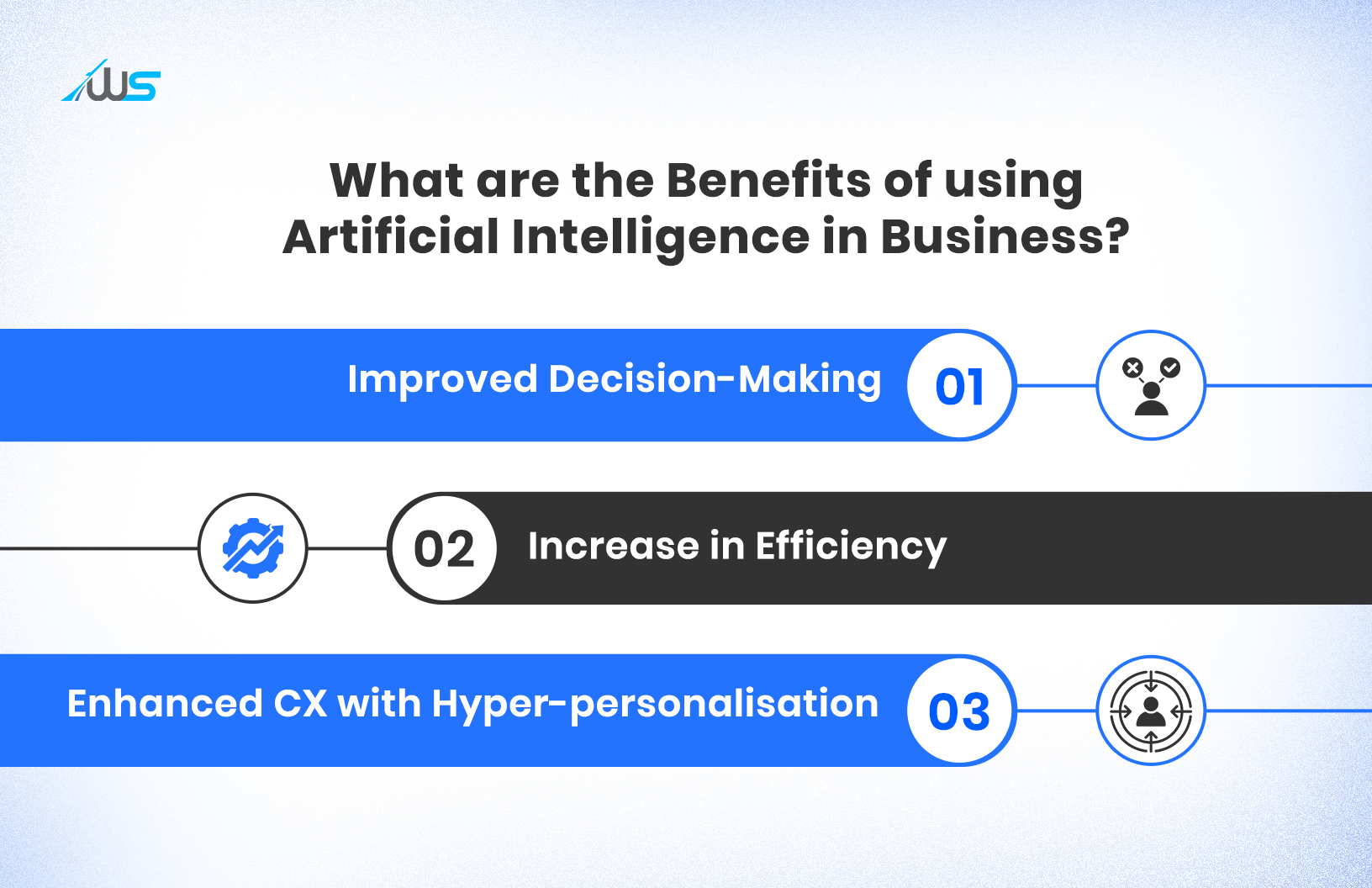
AI helps businesses make smarter decisions by analysing large volumes of data, identifying patterns, and predicting outcomes. It boosts efficiency by automating repetitive tasks, reducing errors, and allowing teams to focus on high-value work. Additionally, AI enhances customer experience through hyper-personalisation, delivering tailored interactions, recommendations, and seamless support.
Let’s look at all these in detail. But first, we have to understand why AI matters.
Why AI in Business Matters?
In the past, technologies have been widely used to increase efficiency, minimise errors, allocate resources more effectively, and speed up processes. Let’s see how AI helps businesses.
Shift to Intelligence from Efficiency
Artificial Intelligence in business transcends this technical boundary, making systems intelligent. It would be wrong to assume that AI only automates or executes tasks. AI learns, makes decisions, and adapts effectively.
This shift enables businesses to move from reactive to responsive strategies. In a way, AI in business enables business efficiency by providing proactive strategies.
For instance, AI-driven systems can detect anomalies that humans miss. Plus, it can predict equipment failures in real time. This can save a ton of disruptions. Furthermore, AI systems can also suggest optimal inventory management practices based on market trends and historical data.
All these abilities can reduce business downtime, improve operational resilience, and minimise waste, thereby enabling smarter resource allocation.
Making Data a Strategic Asset
There is no denying the fact that data is one of the most important assets in the modern business landscape. However, raw and unstructured data is useless. This data needs to be interpreted and then acted upon. Artificial Intelligence is one such technology that excels at this function.
ML algorithms can process large datasets and identify patterns, valuable insights, and relationships that humans can’t uncover manually. This allows businesses to make smarter decisions and can optimise processes.
The incorporation of AI into business can help enterprises identify the segments most likely to convert. It can also give the executive team an idea of which suppliers can offer exceptional value or which strategies will deliver the highest ROI (Return on Investment).
Better CX (Customer Experience)
One popular way everyone knows about AI is its ability to deliver an exceptional CX (Customer Experience). Virtual assistants, recommendation engines, and AI chatbots are now quite common.
These AI tools offer personalised, all-around-the-clock support and guidance. AI not only improve user satisfaction but also guides them throughout the journey, reducing the burden on humans.
Another interesting aspect of Artificial Intelligence in business is that it can assess feedback, sentiment, and behavioural data. This way, businesses can tailor their products, messaging, and services. This personalisation builds formidable relationships and boosts loyalty.
Agility and Predictions
The UK market is transforming; so is the global market. AI in business gives a competitive edge with its predictive capabilities. Be it forecasting demand, identifying trends, or anticipating competitor moves, AI is revolutionising the landscape with its agility.
For example, retailers can leverage AI to set prices based on competitor activity and demand. Even manufacturers can optimise their schedules with AI predictions. Financial institutions, with the help of AI, can detect fraud and minimise risks.
Cultural Shift and Strategic Integration
Businesses need to fully integrate AI into their systems to realise the full potential of these tools. But this should be done strategically. So, a leadership commitment, culture, and cross-functional collaboration are crucial in this regard. In short, businesses have to embrace learning and experimentation.
Not just that, companies have to build a culture that supports AI integration by hiring the right talent and investing in the right infrastructure. It includes data scientists, business analysts, and AI engineers. They need to collaborate and build solutions that align well with business goals.
For that, data lakes, governance frameworks, and cloud platforms are necessary to support compliance and scalability.
Learn More: UK’s AI Ambitions: What AI for Business Means, Trends & More
Now that we know why AI matters for businesses, let’s explore its benefits.
What are the Benefits of using Artificial Intelligence in Business?
AI in businesses uses internal and external data to optimise business processes, automate repetitive tasks, and enable smarter decision-making. These AI benefits work together and cut costs, drive innovation, and strengthen business outcomes. Let’s explore some of them.
1. Improved Decision-Making
AI in businesses can enhance decision-making by processing large chunks of data (structured or unstructured) and identifying patterns. It can even assess market conditions and trends and predict, then recommend the necessary actions.
Use Cases for Generative AI
-
BI (Business Intelligence) queries: One can ask questions and get almost instant insights.
-
Report Automation: Gen AI in business can summarise complex datasets into reports.
-
Scenario Modelling: Businesses can also use Gen AI to create scenarios and possibilities based on variables.
Use Cases for Agentic AI
-
Market Analysis: Agentic AI can monitor competitors, market, or economic trends to recommend optimal actions.
-
Pricing Agents (Dynamic): With Agentic AI, one can adjust pricing dynamically through live competitor, supply, and demand data.
-
Agents to Support Decisions: Agentic AI can gather information, assess options, and provide evidence-based suggestions.
2. Increase in Efficiency
It is a known fact that AI can automate repetitive tasks. This saves a lot of time and minimises human errors, allowing employees to concentrate on high-value organisational functions. As AI operates all day long without getting tired and handles tasks simultaneously, it is hugely beneficial.
Use Cases for Generative AI
-
Content Development: Gen AI can develop marketing materials, documentation, and product descriptions.
-
Debugging and Code Development: It can accelerate the software development process.
-
Automating Emails: AI can generate emails and respond to emails (maintaining the brand tone)
Use Cases for Agentic AI
-
Autonomous Workflow: With Agentic AI, businesses can coordinate complex processes across various departments
-
Self-Optimising Supply Chains: Agentic AI can automatically adjust routing, procurement, and inventory.
-
Recruitment Agents: They can screen resumes, source candidates, manage communications, and schedule interviews for businesses.
3. Enhanced CX with Hyper-personalisation
AI personalises user interactions, provides support, smooth omni-channel experiences, and anticipates needs. With these insights, businesses can deliver hyper-personalised user journeys, leading to higher engagement and satisfaction.
Use Cases for Generative AI
-
AI Chatbots: Gen AI can mimic human-like service by understanding intent, context, and sentiment.
-
Recommendations: It can even suggest recommendations based on user preferences and behaviour.
-
Content Creation: With Gen AI, one can deliver personalised web content, offers, and emails.
Use Cases for Agentic AI
-
Personal Assistants: Agentic AI can learn customer preferences and curate tailored products.
-
Optimisation of the Customer Journey: One can adjust touchpoints throughout the user journey to optimise engagement.
-
Automatic Problem-Solving Agents: Agentic AI can troubleshoot issues without human intervention.
Wrapping Up
Artificial Intelligence in business holds great promise as it can improve various business processes. It is useful for enterprises that prioritise AI.
Over the next few years, organisations will readily adopt AI by prioritising areas where rapid technological advancement is happening. It may include IT automation, cybersecurity, app modernisation, digital labour, and so on.
Are you ready to step up your game in AI, but don’t know where to start? We can help.
Book a call with Webskitters Ltd.’s AI experts and revolutionise your business processes with AI.
FAQs
1. Why is AI important for businesses?
AI helps businesses make smarter decisions, improve efficiency, and stay competitive through data-driven insights.
2. How does AI improve decision-making?
AI analyses large datasets to identify patterns and provide accurate predictions and recommendations.
3. Can AI help reduce operational costs?
Yes, AI automates repetitive tasks and optimises processes, reducing costs and saving time.
4. How does AI enhance customer experience?
AI delivers personalised interactions, recommendations, and 24/7 support to improve customer satisfaction.
5. What is needed to successfully implement AI in business?
Businesses need the right strategy, skilled talent, and proper infrastructure to effectively integrate AI.
