

A customer messages your business at 11pm on a Sunday. By the time you open your laptop on Monday morning, they have already bought from a competitor who replied in seconds. This is not a rare scenario. It happens thousands of times a week across the UK’s small business economy.
Customer support used to mean a shared inbox, a phone that never stopped ringing, and an owner answering the same three questions all day. That model is breaking down. AI-powered chatbot development has evolved into something far more capable: AI agents that understand a request, check an order, update a booking, and resolve the issue without waiting for a human to log in.
This guide breaks down what AI agents actually do, what the latest UK data says about adoption, and how a small business can bring them in without losing the personal touch customers expect.
What Is an AI Agent (And How Is It Different From a Chatbot)?
An AI agent is software that can understand a customer’s intent, pull live data from a business system, decide on the next step, and take action — all without a human writing the rules for every possible conversation in advance. This is the core entity behind the term: not a scripted menu, but a reasoning system connected to real tools.
Older rule-based chatbots could only follow a decision tree: press 1 for billing, press 2 for returns. If a customer phrased their question differently, the bot got stuck. AI agents, built on large language models and natural language processing, interpret intent even when the wording is messy, then call the right backend system to actually solve the problem.
AI Agent vs Chatbot vs Live Chat Software
| Feature | Rule-based chatbot | AI agent | Live chat (human) |
| Understands free-text questions | Limited | Yes | Yes |
| Takes real action (refunds, bookings) | No | Yes | Yes |
| Available 24/7 | Yes | Yes | No |
| Cost per resolved query | Low | £0.50–£2 | £6–£12 |
| Learns from past conversations | No | Yes | Depends on training |
he State of AI Customer Support Adoption Among UK Small Businesses
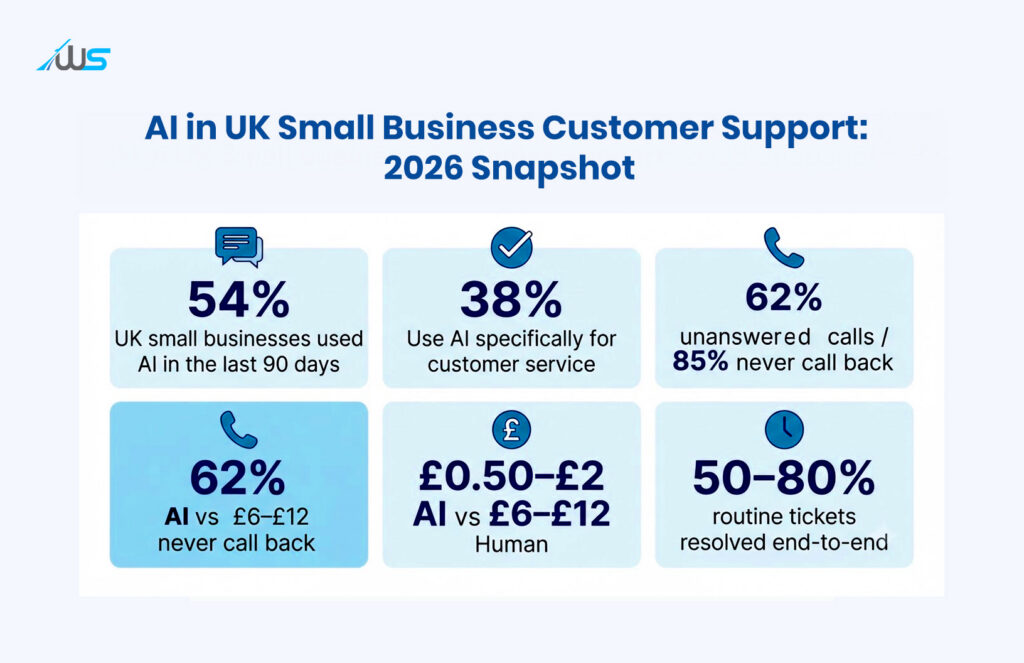
A 2026 Federation of Small Businesses survey found that 54% of UK small business owners had used an AI tool at least once in the previous 90 days, and customer service chatbots are now used by roughly 38% of AI-adopting small firms. Growth has been fast: the Office for National Statistics recorded UK business AI use rising from around 9% in September 2023 to roughly a quarter of all businesses by late 2025, and higher still among firms with ten or more employees.
Adoption still varies sharply by sector and company size, which matters if you are benchmarking your own business against the market.
| Sector / segment | Approx. AI adoption rate (2025–26) |
| Information & communications | 43–51% |
| Financial services | 21–31% |
| Professional services (legal, accounting) | 20–28% |
| Retail, hospitality, education | 11–15% |
| Micro-businesses (under 10 staff) | ~14% |
| Customer service specifically (SME use case) | 31–38% |
Investment is following the same curve. AI-focused companies attracted roughly £2.9 billion across 323 deals in the first three quarters of 2025 alone, close to two-fifths of all UK equity investment into smaller businesses. Customer support is one of the clearest, fastest-paying-back places to start.
How AI Agents Actually Automate Customer Support
AI agents are not just answering FAQs anymore. Modern deployments plug into booking systems, order databases, and CRMs so they can genuinely close the loop for a customer, not just point them to a help page.
1. Instant, 24/7 First Response
An AI agent replies in seconds, any hour, on any day. Since first response time under ten minutes is now considered ‘important’ by 90% of customers on live chat, this alone removes the single biggest source of lost sales for small businesses that cannot staff a night shift.
2. Order Tracking, Bookings and Account Queries
Rather than telling a customer to ‘check your email’, a connected AI agent looks up the order or booking itself, confirms status, and makes the change — cancelling, rescheduling, or issuing a refund within policy limits, without a staff member touching the ticket.
3. Missed-Call Recovery
Phone remains a major blind spot. Small businesses miss an estimated 62% of incoming calls on average, and 85% of those callers never call back — they simply move on. Voice-capable AI agents answer, qualify the enquiry, and either resolve it or book a callback, turning a missed call into a captured lead instead of a lost customer.
4. Smart Escalation to a Human
Good AI agent design is not about removing people — it is about routing only the conversations that genuinely need a human’s judgement, complaints, edge cases, high-value accounts, straight to a team member with full context attached, so nobody repeats themselves.
The Business Case: Cost, Speed and Satisfaction
For a small business owner, the numbers are what make this decision easy to justify. Here is how AI-agent-assisted support compares with a traditional, fully human support model on the metrics that matter most.
| Metric | Traditional human-only support | AI agent-assisted support |
| Typical cost per resolved query | £6 – £12 | £0.50 – £2 |
| First response time | Minutes to hours | Under 10 seconds |
| Availability | Business hours only | 24/7, including weekends |
| Mature resolution rate (routine queries) | N/A (manual) | 50% – 80% end-to-end |
| Customer satisfaction (CSAT) | ~4.3 / 5 | ~4.1 / 5, narrowing with hybrid handoff |
The satisfaction gap between AI and human agents is closing fast, especially where a business uses machine learning to route only routine queries to the AI agent and reserve complex or emotional conversations for a person. That hybrid model, not full automation, is what UK small businesses are actually adopting.
Common Questions UK Small Business Owners Ask About AI Agents
Will an AI agent replace my customer support team?
Unlikely, and most UK SMEs are not using it that way. Current UK research shows most small firms using AI say it is supporting existing staff rather than replacing them, with only a small minority of deep adopters expecting headcount reductions. The realistic outcome is fewer repetitive tickets landing on your team, freeing them for the conversations that need a human.
How much does an AI customer support agent cost for a small business?
Entry-level AI chat agents for small businesses typically run from a modest monthly subscription up to a few hundred pounds a month depending on volume and integrations, well below the cost of one additional support hire. Custom-built agents connected to your own booking or ordering system cost more upfront but usually pay back within months given the £0.50–£2 per-resolution cost quoted above.
Is AI customer support GDPR compliant in the UK?
It can be, but compliance is not automatic. You need a lawful basis for processing customer data, clear disclosure that a customer is talking to an AI system, data retention limits, and a vendor contract that keeps UK customer data appropriately protected. This is a build requirement, not an afterthought.
Can AI agents handle phone calls, not just website chat?
Yes. Voice AI agents, built on the same underlying NLP and machine learning capabilities as chat agents, can answer inbound calls, verify a customer, look up an order, and either resolve the call or transfer it with a summary attached for the human who picks it up next.
How quickly can a small business see results?
Many businesses that deploy AI support agents report measurable value within the first 60 to 90 days, usually visible first in faster response times and fewer missed enquiries, with cost and CSAT gains following as the agent is tuned against real conversations.
Risks and Limitations Worth Planning For
- Hallucinated answers: an ungoverned AI agent can confidently give a wrong policy detail. Guardrails and a verified knowledge base are essential.
- Over-automation: 79% of consumers still say they prefer a human for general support issues, so full self-service for every query type can backfire.
- Data protection: customer data flowing through a third-party AI tool needs a UK GDPR-compliant contract and clear consent.
- Poor escalation design: if handoff to a human loses context, customers repeat themselves and satisfaction drops sharply.
How to Get Started With AI Agents in Your Business
A phased rollout beats a big-bang launch for almost every small business. A practical sequence looks like this:
- Map your ten most repeated customer questions and the exact steps a human takes to answer them.
- Start with one channel, typically web chat or WhatsApp, before adding voice or email.
- Set clear, written escalation rules for what the AI agent must never decide alone.
- Connect the agent to your live order, booking, or CRM data rather than a static FAQ document.
- Track resolution rate and CSAT weekly, not just how many conversations were deflected.
Turning Customer Support Into a Growth Advantage
UK small businesses that treat AI agents as a genuine team member, not a gimmick bolted onto a website, are the ones capturing missed calls, answering at 11pm, and freeing their staff for the conversations that actually need a human touch. The data is clear that adoption is accelerating and the cost of waiting is a slower, less available support experience than customers now expect as standard.
If you are ready to explore what an AI agent could handle for your business, our team can scope a solution built around your existing systems. Get in touch with our team to talk through what a well-built AI agent could do for your customer support.
