

In March this year, Oracle introduced NL2SQL agents, which enable business users to interact with structured enterprise databases using not code, but plain language. That’s agentic AI at play.
So, a user can prompt the platform with ‘Show average revenue per customer this quarter,’ and they will receive instant, actionable answers. And, these answers are personalised to the user’s role, context and intent.
What’s remarkable about that?
It involves a shift from traditional text-to-SQL translation to agentic orchestration. Here, goal-driven agents are able to autonomously reason, plan, act, and self-learn. The former rigid, rules-based tasks are slowly evolving. AI agents are automating complex, irregular, multistep business workflows.
Before we get into how exactly the agentic AI automates business processes, let’s define what agentic AI is.
What is Agentic AI?
Agentic AI is an artificial intelligence framework that uses sophisticated reasoning to autonomously and independently perform highly complex tasks with minimal human oversight.
Since the system has Human-in-the-Loop (HITL) capacities, there are certain checkpoints before critical actions that require a human to sign off on it.
To complete a task, multiple AI agents (each with their own specialisation) work together, and that is what allows the system to achieve a high level of autonomy.
To make the concept clear, let’s imagine you run a supply chain business. You can develop an agentic AI system tasked with reordering inventory. It will autonomously monitor stock levels, analyse demand signals (weather, sales velocity, trends), and place orders with suppliers without human intervention.
Why Is Agentic AI Important For Automation?
Businesses with multistep workflows, particularly, are dependent on agentic AI because it offers them operational efficiency and quick yet intelligent decision-making.
To realise the importance of agentic AI for automation, it is vital to understand how it differs from traditional AI automation.
Agentic AI Vs Traditional AI automation
|
|
Traditional AI Automation |
Agentic AI |
|
How it works |
Waits for step-by-step commands |
Takes initiative and figures out the next steps |
|
Handling change |
Struggles when plans shift |
Adjusts when situations change |
|
Nature of work |
Follows scripts and fixed flows |
Deals with unpredictable, real-world problems |
|
Human involvement |
Humans guide every stage closely |
Humans mostly supervise and review |
|
Overall outcome |
Completes tasks in pieces |
Gets actual work done end-to-end |
TechRadar found that 73% of insights from traditional AI tools never actually get used. In simple terms, a lot of what these systems figure out just sits there.
It neither leads to any decisions nor does it change how the business functions.
What agentic AI brings to the table is the ability to do extremely complex and intricate tasks from start to finish.
That’s why decision-makers are now starting to integrate it within critical processes like customer operations, supply chain coordination, and incident response.
And, this is directly impacting business operations, revenue growth and customer satisfaction.
In fact, McKinsey research estimates that agentic AI could generate around $450 billion to $650 billion in annual revenue by 2030.
Key Ways Agentic AI Automates Workflows
For sectors including IT, retail, healthcare and finance, agentic AI is playing a massive role in making businesses more competitive. Everything is being automated, from decision-making to workflow execution to real-time system responses.
Here are some of the main ways in which business automation is possible with agentic AI.
1. Autonomous Multistep Processes
The good thing about agentic AI in workflows is that it does not stop at one output.
It can take a larger goal and split it into smaller steps, then move through them without waiting for instructions at each stage.
According to Gartner, by 2028, 15% of day-to-day work decisions will be made without human input. It’s clear that decision-making is shifting from people to systems.
Teams no longer have to manually track each stage of progress. The tasks keep running smoothly, even when no human agent is actively pushing them forward.
2. Intelligent Decision-Making
While traditional AI tools are only capable of working with clean, structured data, agentic systems transcend this.
They can read emails, forms, and documents, and still decide what action makes sense next.
In business terms, this reduces the need for people to interpret and pass work forward at every step.
The system can act on the information immediately, at the point it comes in, instead of sending it through multiple steps or people first.
So, say an agent detects fraud. Its next steps would be to block the transaction, investigate the customer’s history across all accounts, calculate the risk of further fraud, and generate a compliance report for the legal team. All that, without human help.
3. System Integration and Collaboration
These systems can function across and in collaboration with CRMs, ERPs, and internal tools while different agents handle different parts of the same task.
So if one part collects information, another can check it, and another can act on it. And, all of it takes place without delays.
Say an agentic AI system encounters an incoming customer email with missing fields. There would be no need to manually review it before the next steps are put into motion. The system can extract what is available and move it into the next step.
4. Continuous Learning and Optimisation
Each time a process runs, the system can store what worked and what failed. It uses memory modules for this.
Since it is self-learning, it causes a loop that reduces repeated mistakes and makes common tasks smoother.
This is especially true in customer support and day-to-day operations, where the same types of requests appear again and again.
An agentic AI platform may recognise that a certain type of IT ticket is usually resolved by resetting access permissions. Consequently, the system will start applying that automatically instead of waiting for someone to repeat the same fix.
5. Dynamic Problem Solving
In the past, AI automation often stopped and waited for a human when something did not match the expected path.
Gartner predicts that by 2029, up to 80% of common customer service issues could be handled without human involvement. This just goes to show how systems are starting to handle problems on their own instead of passing them back to people.
Teams do not have to intervene every time an issue arises. This is because AI agents can resolve issues without waiting for manual recovery steps.
Wrapping Up
So far, automation has been limited to basic tasks. But, as you can see, things will change, and indeed, they have already begun.
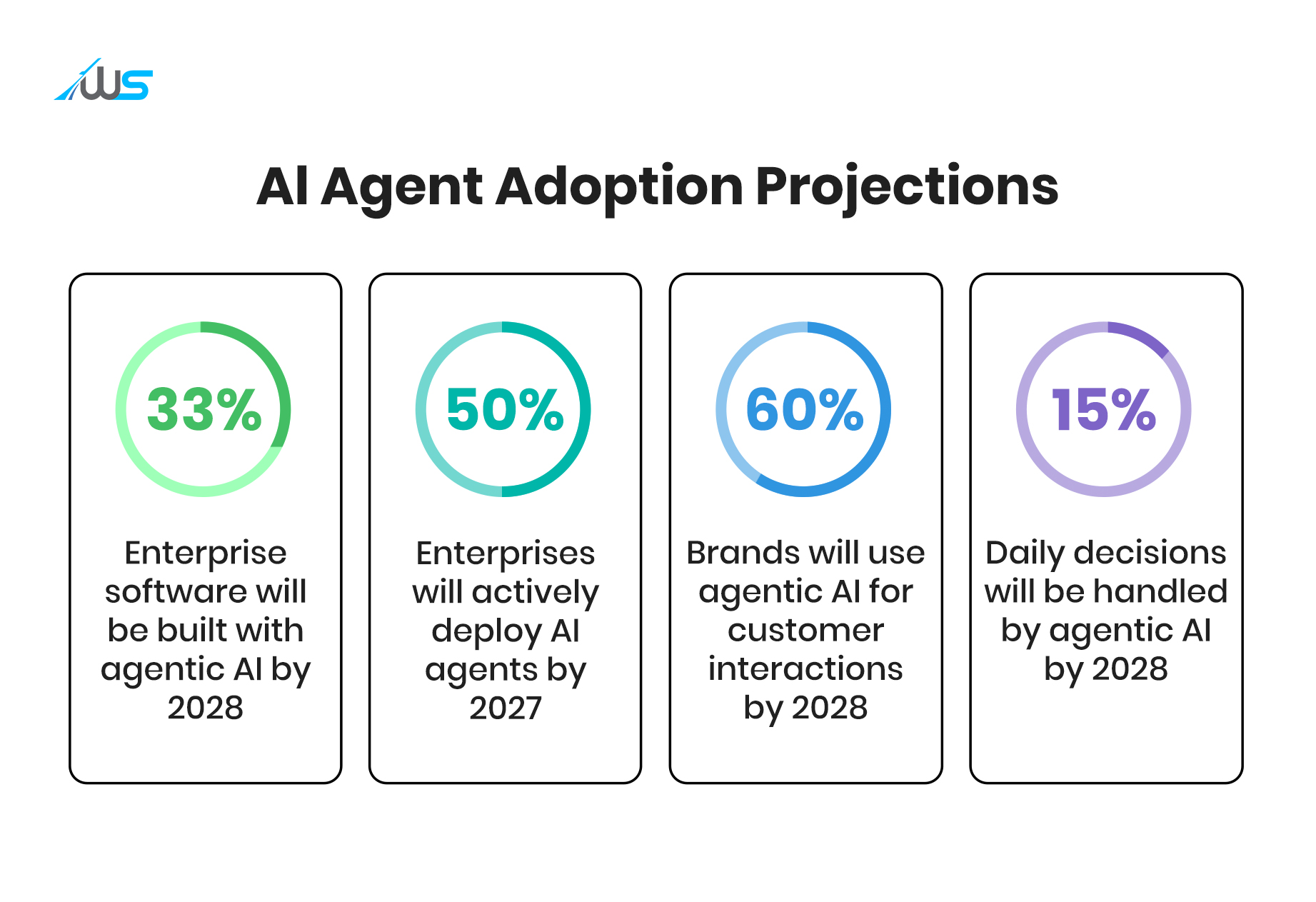
With agentic AI taking the reins, all the process-heavy businesses will deploy it for decision-driven work, directly affecting cost, speed, and output quality.
If you are currently struggling to automate complex workflows, it may be time to rethink how your systems are set up.
Webskitters brings the experience and modern tech needed to strengthen operations and improve ROI. You can reach out to our experts to discuss your project needs.
Frequently Asked Questions
1. What is agentic AI?
Agentic AI refers to systems can plan, decide, and act independently to complete tasks, using goals, context, and feedback instead of relying on fixed instructions.
2. Why is agentic AI important for automation?
Agentic AI matters for automation because it reduces intervention, handles multi-step workflows, adapts to changing inputs, and improves efficiency across business processes without constant supervision.
3. What is the difference between agentic AI and traditional AI?
Traditional AI follows predefined rules or models, while agentic AI can set goals, make decisions, and adjust actions dynamically based on real-time data and outcomes.
4. How does agentic AI automate workflows?
Agentic AI automates workflows by coordinating tasks, integrating tools, analysing data, making decisions, and executing actions across systems without requiring human input at every step.
5. What is the future of agentic AI in automation?
The future of agentic AI in automation includes autonomous systems, deeper integration across platforms, decision-making accuracy, and wider adoption in industries seeking scalable, efficient operations.
