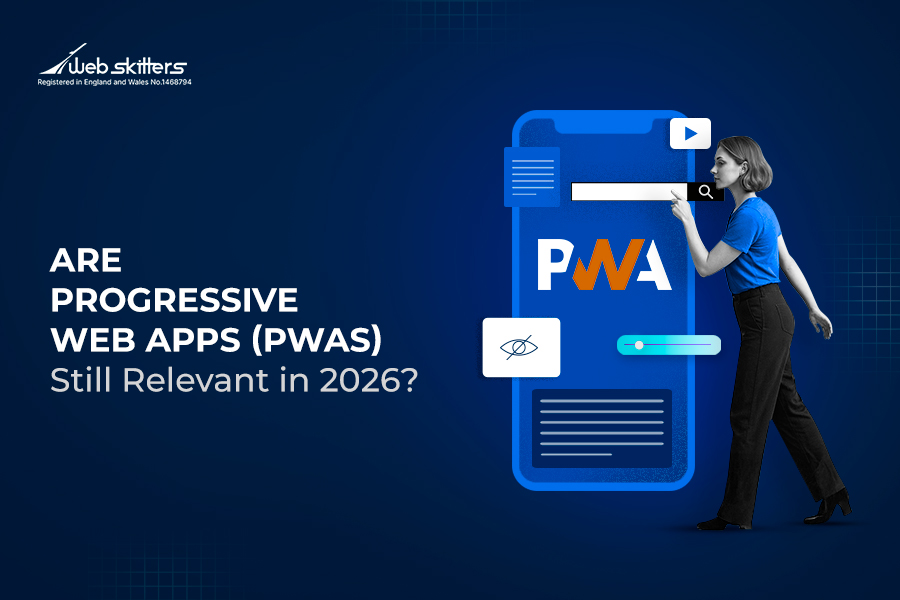

Yes, Progressive Web Apps are still relevant in 2026. The main reason is that development costs for PWAs are much lower than for apps. And, of course, these web apps offer top-notch user experience, which is vital to the success of any online venture.
What do Forbes, Tinder, and Google Maps Go have in common?
They all have Progressive Web Apps (PWAs) that people use online, probably without even realising it.
But, why did the business owners of these top brands opt for PWAs?
The answer is simple. They wanted the broad reach of a website as well as the efficient functionalities of native applications.
This is precisely what PWAs offer (among many other things). You might say it’s the best of both worlds.
PWAs offer a level of flexibility and cost-effectiveness that native apps can’t really compete with.
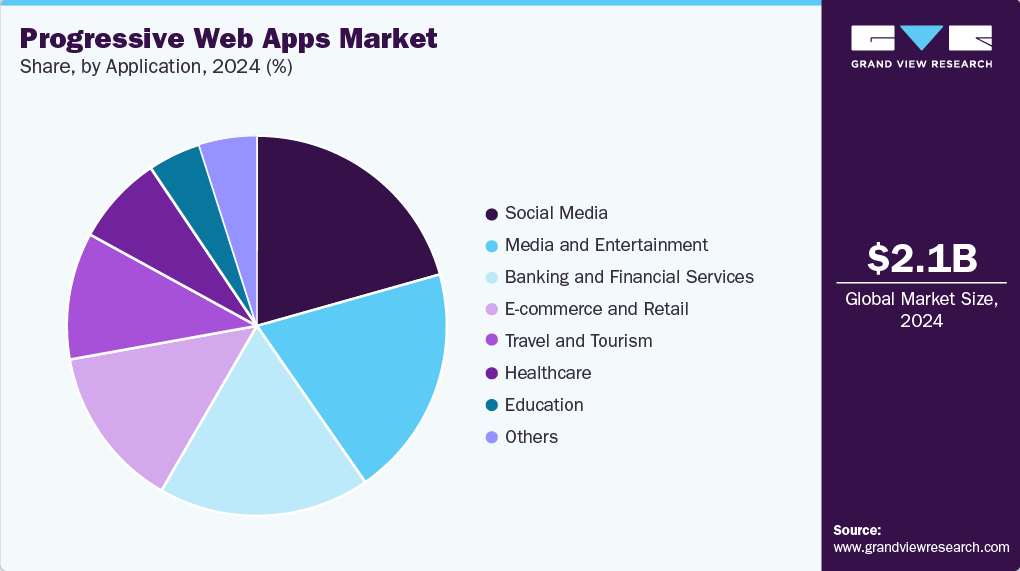
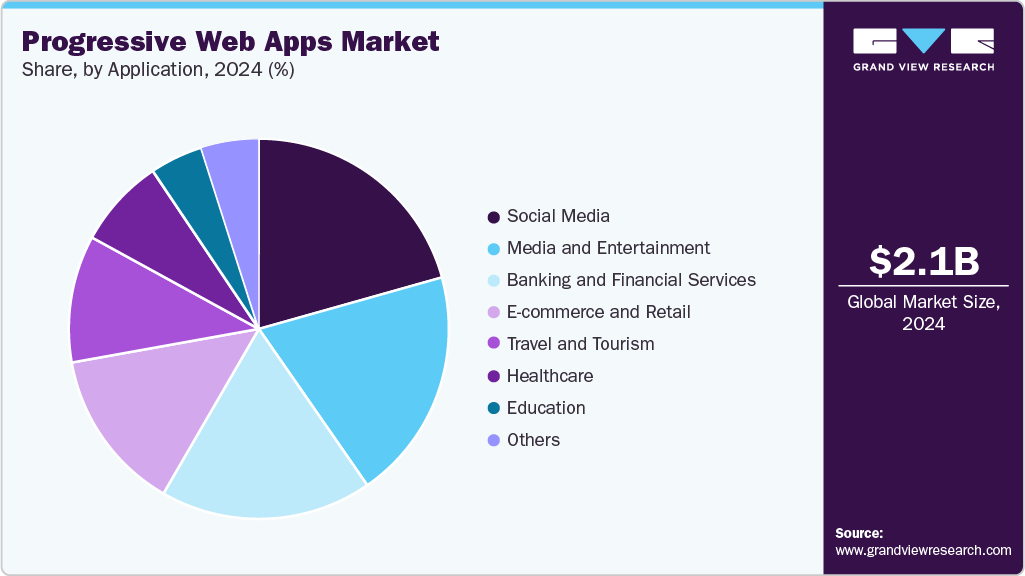
According to Grand View Research, the global market size for PWAs in 2024 was $2.1B. And, demand has not slowed down much.
In 2026, consumers would much rather choose a lightweight and responsive digital platform compared to their traditional app versions.
Go through your phone right now and check how many “lite” apps you have on your home screen. Well, some of them are PWAs.
In this article, you will learn all about PWAs and the reasons why so many businesses are using them in 2026.
What Is a Progressive Web App?
A Progressive Web App, or PWA, is simply a website that looks and behaves like a traditional app on your phone or laptop. It is accessible directly from a web browser (like Chrome or Safari) without requiring app store downloads.
With the help of an experienced progressive web app development company, PWAs are designed to load quickly and even continue to function when users are offline. Users can add it to their home screen without needing to install it from an app store.
This means the entire web experience stays in the browser, yet still feels direct and responsive.
The utter simplicity of the installation process and the automated updates make PWAs a powerful technology for businesses, especially small and medium enterprises (SMEs).
How Do PWAs Actually Work?
It is natural for people to wonder how PWAs manage to feel so smooth. Beyond the surface, there is a simple structure that keeps everything functioning without making you think about the technical parts at all.
We need to create a diagram based on the text in red
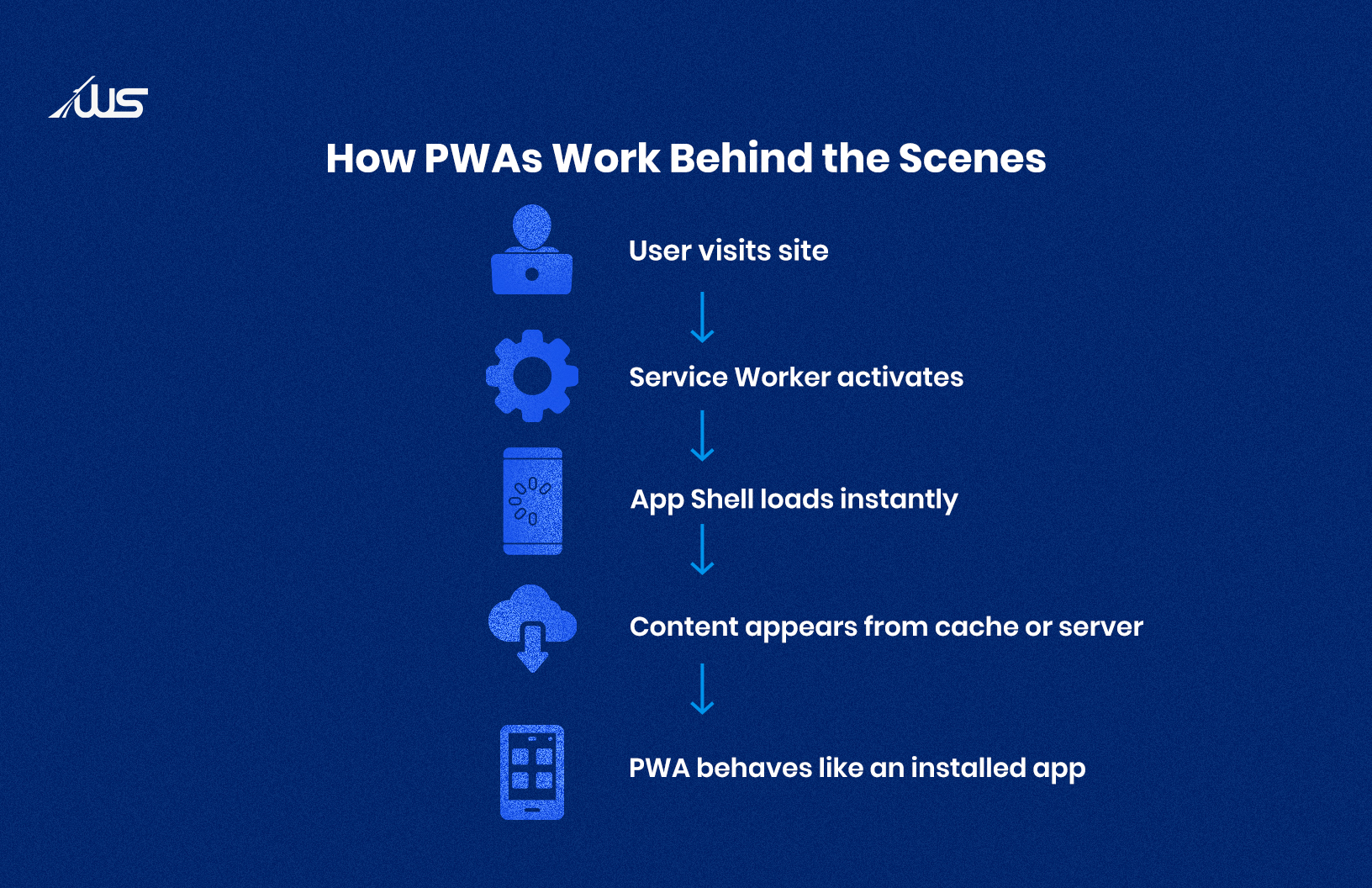
Let’s look at the key components of a PWA:
The App Shell
A PWA begins by loading a basic layout called the app shell. Web developers keep the structure light so the interface appears instantly. The shell remains consistent, while only the data inside changes as people interact with the app.
The Service Worker
A PWA uses a background script known as a service worker. It stores important files, handles requests, and decides whether to pull content from the internet or from the cache. This creates a sense of uninterrupted connectivity for the user, no matter their network conditions.
The Manifest File
A PWA offers an app-like experience because it can tell the device how it wants to appear. The manifest file does that by defining the name, icon, theme colour, and orientation. You could just think of it as a simple settings file that helps the device display everything properly without extra effort.
Native Apps vs Web Apps vs PWAs: The Key Differences
The type of business you run should determine which app you choose. While apps can broadly be classified into web apps and native apps, there are also PWAs, which are a subset of web apps. Each option behaves differently and suits different business needs.
Native Apps
These are apps that run directly on the operating system and feel deeply integrated. They are usually downloaded through app stores.
-
Built for specific device systems and high performance
-
Works offline with deep hardware access
-
Requires app-store approvals and installations
-
Updates need user download and device storage
Web Apps
A web app is a type of program that runs within a browser and does not require installation. They deliver functionality through URLs.
-
Accessible anywhere with an internet connection
-
Easy to update instantly
-
Limited access to device features
-
Relies heavily on network quality
Progressive Web Apps
Along with their app-like features, PWAs are also highly accessible for users. They offer a lightweight web experience with greater search engine reach.
-
Installable straight from the browser
-
Loads fast with built-in caching
-
Works offline to an extent
-
Consistent across all major devices
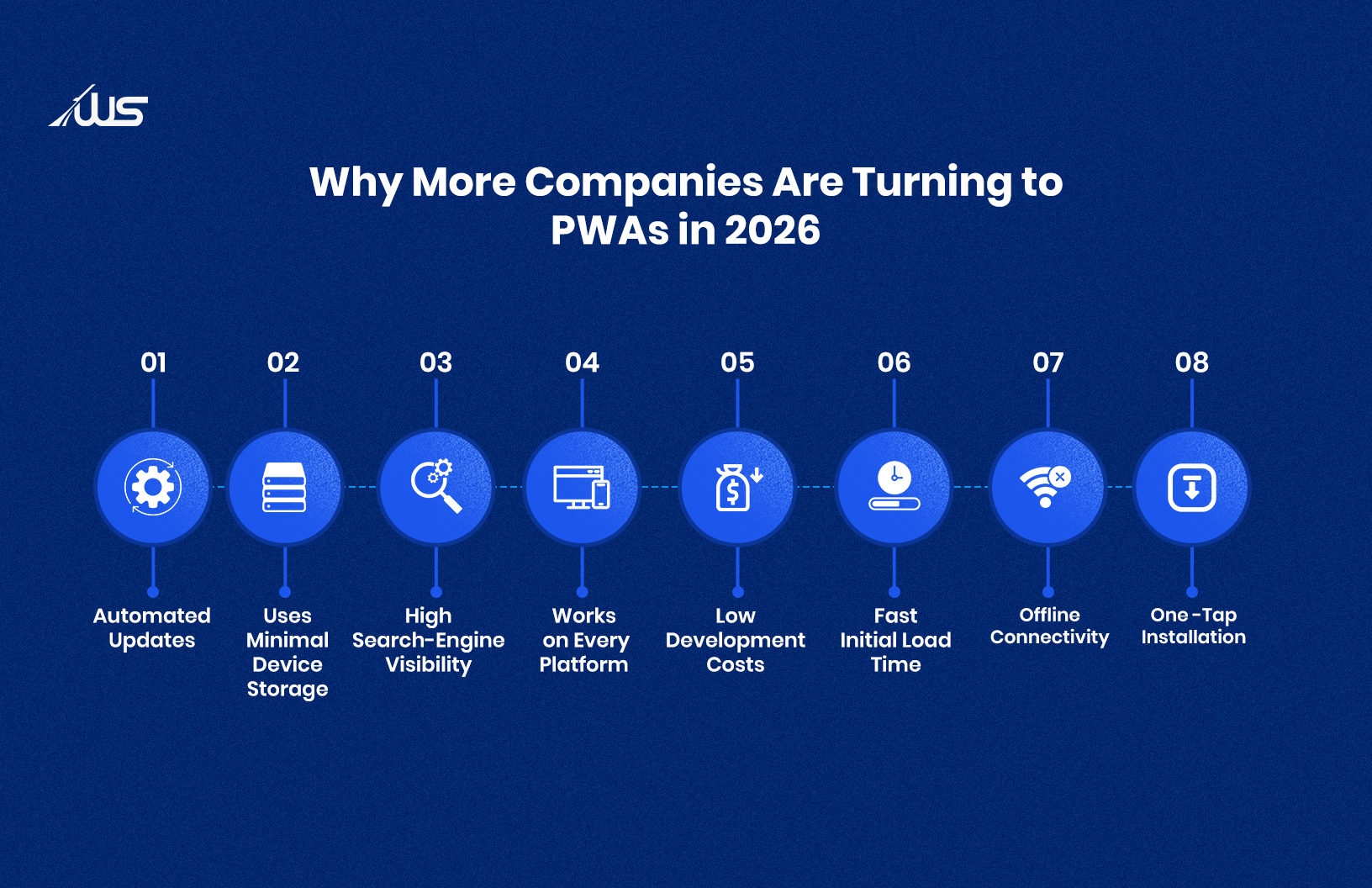
8 Reasons Why Businesses Are Choosing PWAs in 2026
Need the text in red to be made into an infographic
According to Adobe, PWAs can boost your user engagement by 137%.
So, if you are wondering, ‘Are Progressive Web Apps still a thing?’ The answer is yes. PWAs are most definitely still popular and will continue to evolve as cutting-edge technologies like Artificial Intelligence, AR/VR, and WebAssembly advance.
As a business owner, if you realise how users switch between devices today, you would understand why PWAs fit that shift so naturally.
So, if you are looking to boost your business’s reach and conversions, you can take advantage of progressive web app development services.
Here’s why your competitors choose PWAs:
1. Handle updates easily
What makes PWAs so appealing is that updates occur automatically in the background.
There is no pressure on users to download a new version because the service worker handles everything behind the scenes.
A Carnegie Mellon study found users update apps only about 54% of the time.
The fact that a large number of people ignore or delay update prompts on native apps is a major reason why businesses appreciate the simplicity of PWAs.
This technology keeps everyone on the latest version without interruptions or downloads. It also reduces errors caused by outdated builds, meaning support teams face fewer complaints.
2. Require less storage
You do not even have to think about storage management when using a PWA. This is because they take up a fraction of the space compared to native apps, since they store only essential files.
This matters for devices that have limited memory or where users frequently uninstall apps to make space.
It is best to focus on how this improves retention, since apps that feel heavy are often discarded quickly. Lighter experiences tend to stay installed longer and reduce churn.
3. Being discoverable on search engines
Just like a regular website, PWAs are also discoverable on search engines. They appear in search results, giving businesses organic visibility that native apps simply cannot match.
This makes onboarding smoother because users arrive directly through a link rather than an app store.
If you want steady inbound traffic without paid acquisition, this becomes an advantage. Search visibility also amplifies your brand’s reach in competitive markets.
4. Cross-platform reach
Like many businesses, you may want to reach users on mobiles, desktops, tablets, and so forth, without the headache of maintaining several codebases.
The great thing about PWAs is that they work across nearly all modern browsers. Accordingly, the cost of progressive web app development services is significantly low.
Other than cost savings, the wider reach also gives businesses access to users who avoid app stores entirely.
5. Lower long-term development cost
Do you know the ongoing cost of maintaining native apps? Many underestimate it.
PWAs require only one codebase, which simplifies updates, testing, and debugging. This reduces both time and financial investment over several years.
What you must realise is that lower overhead means you can allocate your budget toward growth rather than maintenance.
It also makes experimentation easier because changes get deployed instantly and universally.
6. Faster initial load
When it comes to maintaining a web presence, it is important to keep early impressions smooth so people do not bounce (i.e., exit your web app).
PWAs load quickly due to pre-caching and lightweight architecture. This creates a sense of speed even on slower connections.
If you observe user behaviour, delays often cause people to leave your site. So a faster start matters. A smooth initial load also sets the tone for the rest of the session and encourages deeper interaction.
7. Offline continuity
Disruptions tend to occur when users browse online, and not everyone is likely to have a stable network.
PWAs offer a level of offline continuity by using cached content (copies of files stored in a temporary location).
This way, if the internet connection fluctuates, blank screens or broken pages do not occur. It keeps essential features available so users can continue basic tasks. The steadiness of this experience improves trust and reliability, which many businesses aim for.
8. Quick and easy installation
No one is suggesting that PWAs should replace every native app. But you can’t deny the fact that they offer friction-free onboarding.
Users can install them straight from the browser with a single tap. This reduces drop-offs caused by app-store journeys.
What makes this valuable is its immediacy, since curiosity often fades when extra steps are required. A shorter path increases the likelihood of conversions and repeated use.
Final Thoughts
When Pinterest, the popular image-sharing platform, launched its PWA, it saw a 103% increase in weekly active users.
What does that mean?
It simply shows that people respond to lighter, faster experiences without being told to. You might be weighing the same decision for your business, and it is completely reasonable to feel unsure about the direction.
The truth is, you do not need to rush anything, but it helps to check what your users struggle with today. If your website experiences slow performance or low retention, a PWA may be just what you need.
If you are looking for a leading progressive web app development company, look no further. Webskitters Ltd. is well-known globally for providing successful end-to-end development services that exceed expectations. Let’s get started on your PWA development project.
Frequently Asked Questions
1. What is meant by progressive web apps?
A progressive web app is a website that works like a mobile app. You can open it in your browser, save it to your home screen, use it offline for certain tasks, and get fast loading without installing anything from an app store.
2. How do I install a progressive web app?
Just open the website in your browser. If it is a PWA, you will see an “Add to Home Screen” or “Install” option in your browser menu or as a small prompt. Tap it once, and the app icon appears on your device instantly.
3. What are some popular progressive web apps?
You may already use a few without realising it. Twitter Lite, Pinterest, Spotify Web, Uber Web, and Google Maps Go are all PWAs. They open in the browser but behave almost like native apps.
4. Is PWA the future of web development?
PWAs are a strong part of it because they load fast, work across devices, and cost less to maintain than native apps. They also remove app-store steps, which helps businesses get more users quickly. They are not replacing native apps entirely, but they will keep growing.